


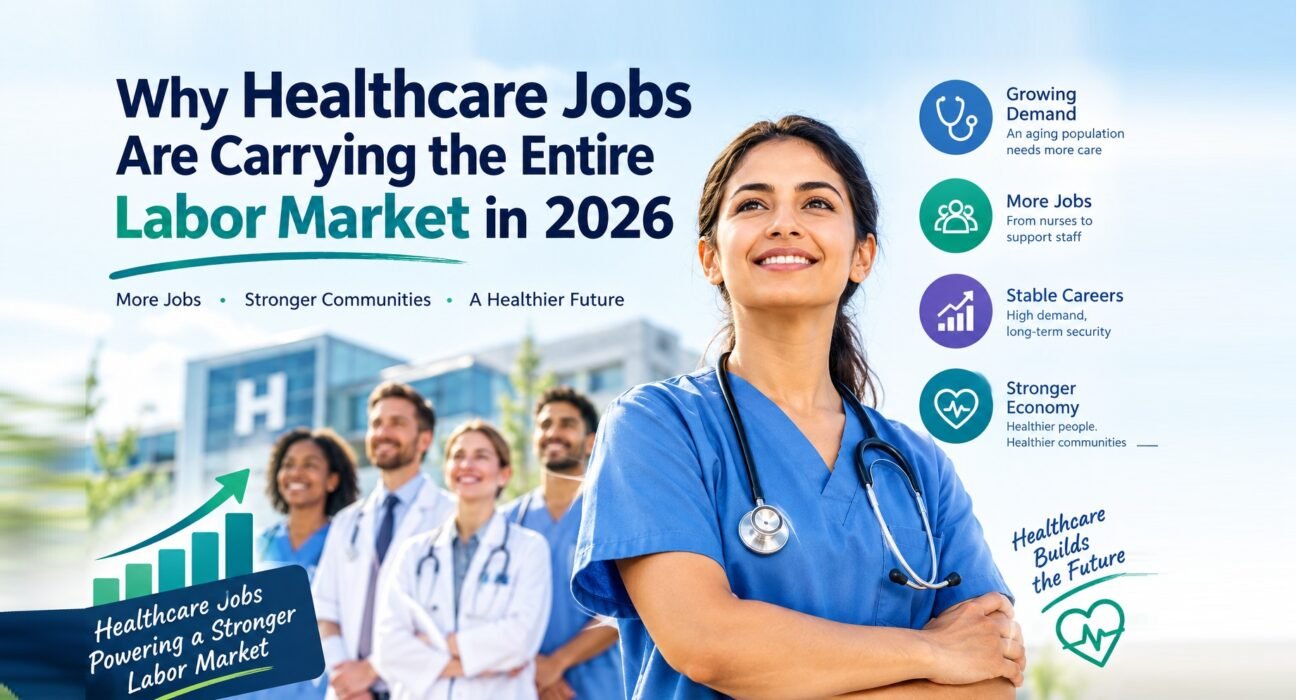
Look past the headlines about layoffs and hiring freezes for a second, and a pretty specific pattern shows up in this year’s labor data, over and over, no matter which report you check. Healthcare is doing almost all of the heavy lifting. One recent labor market analysis, cited by Axios, put it starkly: healthcare accounts for only about 11% of total jobs in the U.S., but it’s responsible for roughly 72% of the job growth happening across the entire market right now. Everything else combined is barely moving the needle in comparison.
The rest of the market is telling a much flatter story
Government jobs reports released this year describe conditions in a lot of traditionally cyclical sectors — the ones that usually drive hiring booms during a recovery — as soft, even outright weak in places. The biggest monthly job gains keep coming from healthcare and social assistance specifically, alongside leisure and hospitality, while a lot of other white-collar and corporate sectors are stuck in a holding pattern. Some are expanding a little. Plenty are simply stabilizing after a rough couple of years. Others are in a longer, quieter decline that doesn’t make for a dramatic headline but shows up clearly enough in the underlying numbers.
Tech occupies a strange middle position in all of this, worth calling out separately. Hiring there has pulled back noticeably from its post-pandemic highs, and plenty of people who spent 2022 and 2023 in tech layoffs know that firsthand. But it’s still considered one of the more realistic fields for a mid-career switch, and specific roles like data scientist and solutions architect are still landing on lists of the year’s higher-paying, higher-demand jobs, even as broader tech hiring cools.
Why healthcare and education are holding up while other fields wobble
The honest answer is that a lot of healthcare and education work is genuinely hard to automate cleanly, in a way that’s different from how a lot of office work has proven vulnerable. These are fields built around judgment calls made in real time, physical presence that can’t be outsourced to software, and situations that rarely repeat in exactly the same way twice — a nurse adjusting a care plan based on how a patient actually looks that morning versus what the chart says, a teacher reading a classroom’s mood and changing the lesson on the fly because a planned activity clearly isn’t landing. That kind of adaptive, human-in-the-room work resists the sort of straightforward automation that’s been reshaping data entry, basic customer service, and some entry-level coding tasks over the past couple of years.
It’s not that AI has no presence in healthcare at all — it’s showing up in diagnostics, scheduling, documentation, and plenty of other places behind the scenes. But the core work of directly treating and caring for people hasn’t become something software can simply take over end to end, and most credible forecasts don’t expect that to change meaningfully anytime soon, even as the tools around clinical work keep improving.
What this actually means if you’re job hunting right now
If you’re in a field that’s currently flat or shrinking, it’s worth being honest with yourself about whether that’s a temporary dip tied to broader economic conditions or a longer structural shift — this year’s labor data suggests some of it is genuinely the latter, not just a rough quarter that’ll correct itself on its own. That doesn’t mean everyone reading this should retrain as a nurse tomorrow; that’s not realistic advice for most people, and I wouldn’t pretend otherwise. It does mean fields adjacent to healthcare — medical administration, behavioral health support, health tech, direct caregiving roles — are worth a serious, unhurried look if you’re already weighing a career change, since demand there has kept growing even while other sectors stall out.
If you’re already working in healthcare or education, this is a reasonable moment to feel a bit more secure about the field itself as a whole, even if any individual job search still takes real effort and doesn’t happen overnight. Strong demand industry-wide doesn’t mean every specific opening is easy to land, especially in competitive metro markets — but it does mean you’re not swimming against the current the way workers in some other sectors currently are.
For job seekers more broadly, the practical lesson buried in this year’s data is less about chasing whatever single industry happens to be hottest right now, and more about honestly weighing how resistant a given role actually is to automation — not just whether it’s growing today, but whether the underlying type of work involved is the kind a machine can realistically take over within the next few years, not just the next few months.