


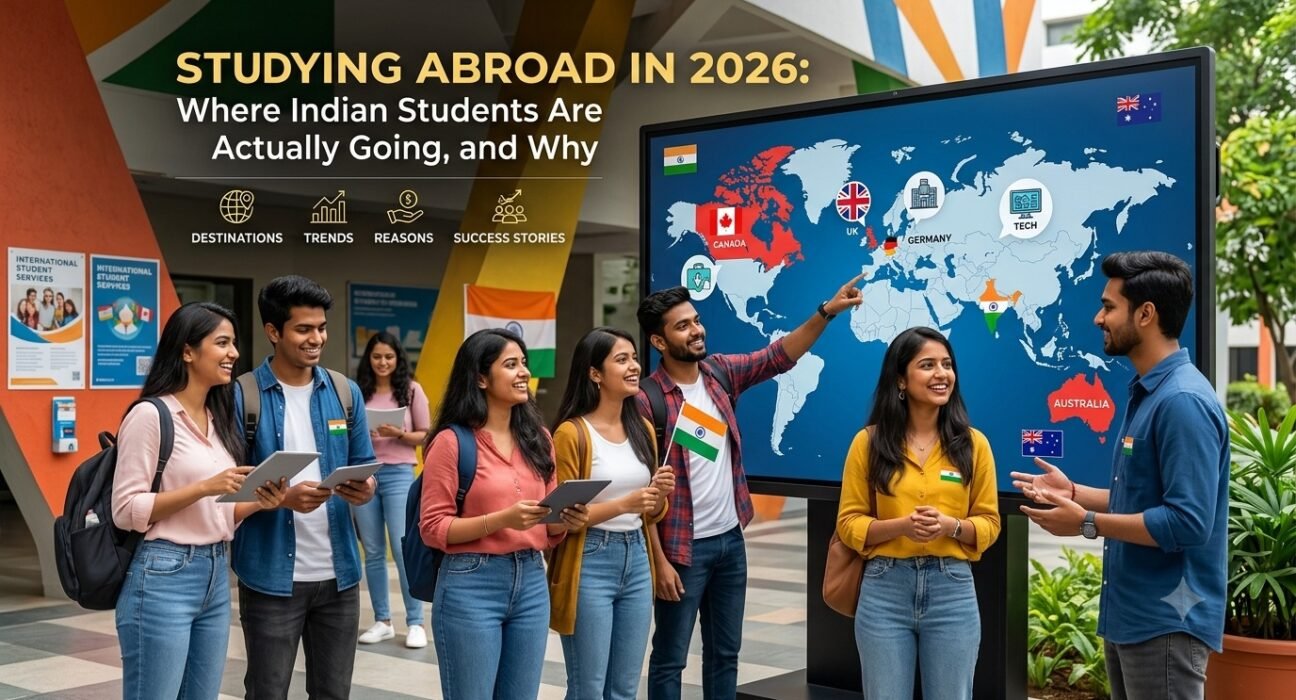
A decade ago, “studying abroad” meant picking one of four countries and hoping it worked out. Not anymore. Roughly 1.88 million Indian students are now studying across 153 countries and that number kept climbing even as visa rules tightened in several of the “safe” destinations. This has stopped being a niche path. It’s mainstream now, and honestly, the thinking behind it has gotten a lot sharper too.
What actually changed
Rankings used to drive almost everything. Get into the highest-ranked school you can, sort the rest out later. That’s shifting. Students today weigh career outcomes, cost of living, and visa stability more heavily than prestige alone mostly because visa policy keeps moving, sometimes mid-program, and nobody wants to build a five-year plan on rules that might not exist in year three.
The “Big Four” aren’t losing, exactly just not gaining the way they used to
Canada, the US, UK, and Australia still pull in the largest numbers of Indian students, and that’s not about to flip overnight. But the balance between them is shifting in a way worth paying attention to. QS Global Student Flows forecasts have the UK overtaking both Canada and the US by 2030 growing from around 146,500 Indian students in 2025 to roughly 184,300 five years later. Canada, currently sitting at number one, is actually projected to decline over that stretch. Germany’s expected to grow faster than any major destination besides France.
None of this makes Canada or the US bad choices. It just means the gap between “the obvious pick” and “the smarter alternative” is closing faster than most people realize.
Where it’s genuinely worth a look
The UK is still home to some seriously well-regarded universities across business, engineering, healthcare, law, and tech, and its projected growth through 2030 suggests it’s not slowing down its investment in international students.
Ireland’s one of the fastest-growing destinations for Indian students right now, and once you look at what’s actually there, it’s not hard to see why — a dense cluster of multinational tech and pharma companies. Going into data analytics, AI, or computer science specifically? The job market after graduation looks noticeably better here than rankings alone would suggest.
Germany gets cited constantly as the best return on investment in this whole conversation, mainly because public universities are free or close to it. It’s also cleaning up its admissions process including a newer digital master’s test for select programs — which matters if you’ve ever dealt with how confusing international applications usually are.
Canada still hosts more Indian students than anywhere else overseas enrolment recently crossed 1.335 million, with spending running into the trillions of rupees. Multicultural cities and relatively student-friendly immigration policy still make it a solid call, even with growth cooling a bit.
And then there’s Australia, Japan, and the UAE. Australia’s steady on education quality and post-study work rights. Japan’s turning into a real alternative for anyone interested in robotics, engineering, or tech broadly more English-taught programs and government scholarships than existed even a few years back. Dubai’s drawing interest for expanding international campuses and, frankly, just being close to home.
Pick the country before the university most people do it backwards
Ask, in this order: what’s the realistic path to working there after graduation, and is that policy actually stable right now, not just last year? What’s the true cost once you factor in living expenses, not the tuition number on the homepage? And does the country actually have an industry presence in your field? Ireland’s tech and pharma cluster matters a lot more to a CS student than any general ranking ever will.
A rough timeline
Give yourself 12 to 18 months before your intended intake to start research and test prep. Shortlist 4 to 6 universities across two countries by month nine. Lock down applications, financing, and visa paperwork by month six. And keep a backup country in your shortlist — visa delays happen often enough that flexibility isn’t optional, it’s just basic planning.
Where this leaves you
The students doing well out of this decision in 2026 are the ones looking past the obvious four countries. The traditional favorites are still solid. But Ireland, Germany, and Japan keep proving, pretty consistently, that “less obvious” doesn’t mean worse — usually it just means better value that hasn’t caught up with its reputation yet.
Sources: NITI Aayog overseas education data; recent Indian student mobility reporting.