


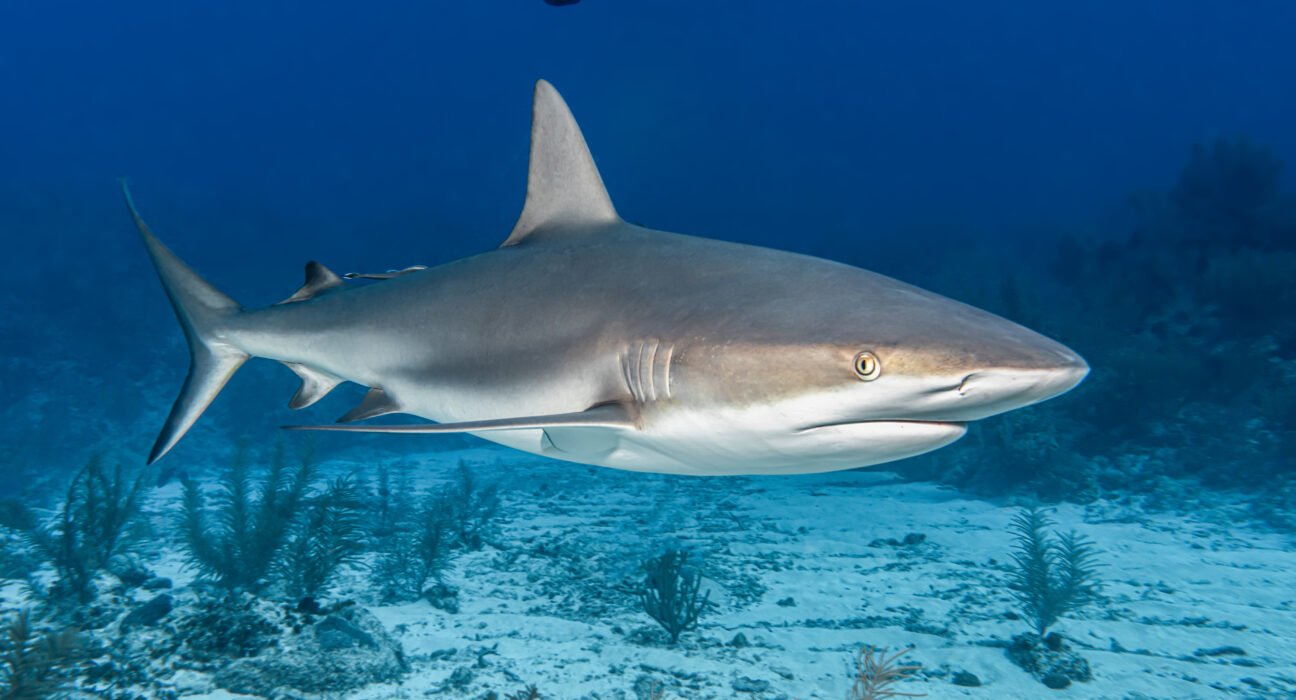
Imagine an animal born before the United States existed that is still swimming today. That isn’t science fiction. It may be what the Greenland shark does. These slow, ghostly fish live in the icy North Atlantic and Arctic, and they hold one of the strangest records in the animal kingdom.
How long do Greenland sharks live?
Longer than any other known vertebrate. They may live up to 400 years, though around 270 is more likely. The most famous study used radiocarbon dating on eye lenses. It found a life expectancy of at least 272 years, with some sharks possibly reaching about 392, give or take about 120 years. That large “give or take” matters. Scientists can’t be exact because these sharks don’t have the hard growth rings used to age many other fish. Their soft vertebrae lack those bands.
For perspective, that’s roughly twice the age of the longest-living land animal, the giant tortoise. A Greenland shark born in the 1600s would have been swimming when the Pilgrims were settling Massachusetts.
How do Greenland sharks live so long?
Nobody knows for certain, but the main clues are about slowing down.
Cold water. They live in water barely above freezing. The cold, dark depths give them such a slow metabolism that individuals have a life expectancy of at least 272 years. Cold slows down chemical reactions in the body, including the ones that cause wear and tear.
Slow growth. One shark tagged in 1936 had grown only 2.3 inches when it was found 16 years later. That’s about a centimeter a year. Slow growth means slow aging.
Late adulthood. They don’t reach reproductive age until around 150 years old. Some estimates are lower, but all are far later than most animals. Pregnancy may last up to 18 years.
Possible genetic help. Scientists are studying the shark’s DNA to see if it has special repair systems that keep cells healthy. That research is still early, so treat it as a promising lead rather than a proven answer.
Put simply, this shark lives life in slow motion. It swims at a leisurely pace, grows slowly, matures slowly and ages slowly.
What do Greenland sharks eat?
Almost anything they can catch or find. Their diet includes other sharks, skates, eels, herring and many other fish. They are primarily scavengers and fish eaters. They also eat seals, though scientists once assumed that was just scavenging. Newer research suggests they are active hunters of marine mammals, despite their slow pace.
Fishermen have found everything from fish to seal parts in their stomachs. They’ll eat dead whales, too, which is why they sometimes gather around carcasses.
There’s an odd twist about their meat. It contains chemicals that make it toxic when fresh. In Iceland, fermented Greenland shark, called hákarl, is considered a national dish and is eaten after a long process of fermentation and drying. If you’ve seen travel shows where hosts gag on it, that’s the dish.
Are Greenland sharks dangerous?
For people, almost never. There is no confirmed risk of Greenland sharks to people. An 1859 report of a human leg in a shark’s stomach was never corroborated. Another source says that although they are big and strong, there has never been a single verified attack on humans.
The main reason is simple: they live in frigid, deep water where few people swim. Divers do sometimes film them in places like the Arctic, and the sharks generally act sluggish and curious, not aggressive. Still, they’re wild animals, so keep a respectful distance.
How many Greenland sharks are left?
Nobody has an exact number, and that’s part of the problem. Scientists lack a solid population count because the sharks live deep, far away and in remote places. Because they are rare to spot and little research has been done, the extent of their population is unknown, though it is estimated to have decreased.
One estimate says populations are thought to have declined by 30 to 49%. The conservation status is a bit confusing, since different sites list different labels. One report says that in 2020 the IUCN Red List status worsened from Near Threatened to Vulnerable. Several other sources also call them Vulnerable. A few pages still say Near Threatened, which is an older label. Check the IUCN Red List for the latest.
What threatens them?
Bycatch. The big problem is getting tangled in fishing gear meant for other fish. Since the 1960s, they have been threatened as bycatch in trawl, longline and gillnet fisheries. One report estimated about 3,500 Greenland sharks are caught as bycatch in international waters each year.
Past hunting. In the early 20th century, people hunted them for liver oil. Today, they are no longer commercially harvested.
Slow recovery. Because they mature so late, losing even a few adults hurts. If they can’t reach maturity, it’s almost impossible for the population to recover. A shark killed today may take well over a century to replace.
Climate change. Warming Arctic waters and melting ice could change the food web they depend on. Scientists are still working out how.
- The first photograph of a live Greenland shark wasn’t taken until 1995.
- Some have speculated that Greenland shark sightings may be behind the Loch Ness monster myth.
- Despite the name, they’ve been spotted as far away as the western Caribbean.
- They’re the largest fish in the Arctic Ocean and the only shark found there year-round.
- They have been found as deep as about 2,200 meters.
- Many have parasites called copepods hanging from their eyes, which can make them partly blind. They seem to do fine anyway, probably by relying on smell.
Greenland sharks tell a story about time. They were already adults when the U.S. was founded, and they may outlast many of us. Scientists also hope their biology will teach us something about aging, tissue repair and disease. If we figure out how they stay healthy for centuries, that knowledge could someday help humans, though that’s a long way off.
They also remind us how little we know about the deep ocean. We can send probes to Mars, yet we still can’t say how many of these giants are out there.
Question Short answer
How long do they live?
At least 270 years, possibly about 400
What do they eat?
Fish, skates, other sharks, eels, seals and carrion.
Are they dangerous?
No verified attacks on humans
Why do they live so long?
Cold water, slow metabolism and slow growth, maybe helped by their genes
Disclaimer: Times of Silicon strives to provide accurate and up-to-date information. However, we cannot guarantee the completeness or accuracy of all content.